
Why some nests are impossible to find
In valley chalets, wasps often build inside the walls: behind cladding, between two panels, in a false ceiling or a roof box. From outside, all you see is a small gap where wasps go in and out. The nest itself can be more than a metre away from that entrance.
A common sign: wasps appearing in a room with no window open, or a faint buzzing inside a wall in the afternoon.
How the thermal camera works
A wasp colony keeps its nest warm to raise its larvae. That heat passes through the timber of the panelling or ceiling. The thermal camera does not see through the wall, but it measures the surface temperature: where the nest is, the wall is clearly warmer than elsewhere.
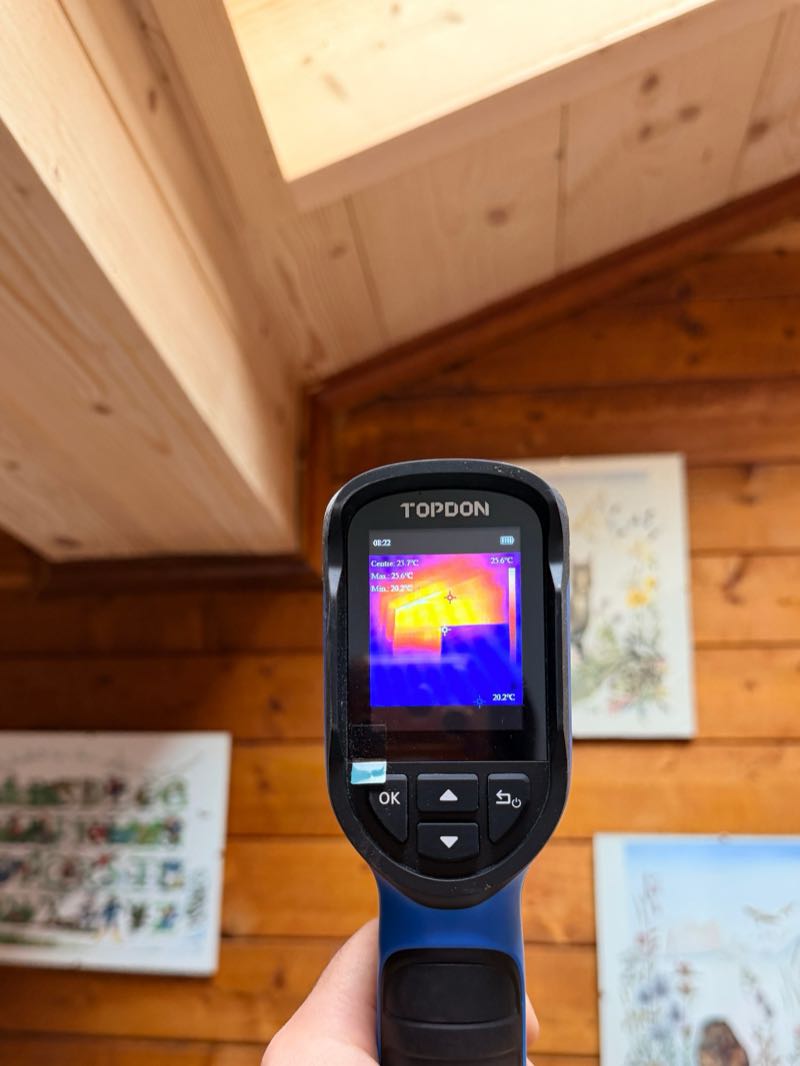
On the job above, the wall over the nest reached 25.6 °C, against 20.2 °C right next to it. A difference of more than 5 °C leaves no doubt about where the colony is.
What it means for you
- The treatment goes in the right place, with less product.
- In the vast majority of cases there is no need to remove cladding or open the wall.
- You know whether the nest is small or already well developed.
- After treatment, we can check that the colony has stopped giving off heat.
The limits of the method
A thermal camera is not magic. Thick insulation between the nest and the wall dampens the heat. A sunny wall is warm all over and hides the nest: readings are more reliable in the morning or on a shaded wall. That is why I always combine it with watching the wasps’ comings and goings and listening to the wall.
Think you have a nest inside a wall?
- Never block the gap: the wasps would look for a way out into the house.
- Don’t drill into the wall or spray insecticide into the entrance.
- Note exactly where the wasps go in and out.
- Call me or send me a photo of the entrance.
I remove nests hidden in walls, roofs and lofts throughout the Chamonix valley. See prices or read wasp nest under a chalet roof.